-
Junior Member
registered user
Yeah, I've spread some of my questions around a bit....Sorry! I'll keep them here now. I'm very grateful for your help!!
I'll post that dmseg output in a few minutes. Right now I'm booted in Red Hat 9 researching this thumbdrive problem. But here's some interesting information for you:
None of the windows formatting utilities gave me a choice in partitioning. Its not like using fdisk on a harddrive. You're given a choice between fat16 and fat32, and a quick or thorough format....that's it. After formatting, windows shows no partitions.
The strange thing is....only my knoppix is seeing multiple partitions?!!! When I booted up my Red Hat 9 this morning and plugged in the thumbdrive, then browsed the hardware:
/dev/sda
/sda1 1 1016 250 fat32
It doesn't seem to see any partitions.
This is definately more complicated than it needs to be!! Are these Phantom partitions?
-
Junior Member
registered user
demesg.........
.
Initializing USB Mass Storage driver...
usb.c: registered new driver usb-storage
scsi2 : SCSI emulation for USB Mass Storage devices
usb-uhci.c: interrupt, status 3, frame# 1380
Vendor: Generic Model: STORAGE DEVICE Rev: 1.25
Type: Direct-Access ANSI SCSI revision: 02
Attached scsi removable disk sda at scsi2, channel 0, id 0, lun 0
SCSI device sda: 512000 512-byte hdwr sectors (262 MB)
sda: Write Protect is off
sda: sda1 sda2 sda3 sda4
WARNING: USB Mass Storage data integrity not assured
USB Mass Storage device found at 2
USB Mass Storage support registered.
usb-uhci.c: interrupt, status 2, frame# 613
usb.c: USB disconnect on device 00:10.2-1 address 2
SCSI disk error : host 2 channel 0 id 0 lun 0 return code = 70000
I/O error: dev 08:01, sector 0
Device 08:01 not ready.
I/O error: dev 08:01, sector 2
sda: Unit Not Ready, sense:
Info fld=0xa00 (nonstd), Current 00:00: sns = 70 2
Raw sense data:0x70 0x00 0x02 0x00 0x00 0x0a 0x00 0x00
sda : READ CAPACITY failed.
sda : status = 1, message = 00, host = 0, driver = 08
Info fld=0xa00 (nonstd), Current sd00:00: sns = 70 2
Raw sense data:0x70 0x00 0x02 0x00 0x00 0x0a 0x00 0x00
sda : block size assumed to be 512 bytes, disk size 1GB.
sda: test WP failed, assume Write Enabled
sda: I/O error: dev 08:00, sector 0
I/O error: dev 08:00, sector 0
ldm_validate_partition_table(): Disk read failed.
I/O error: dev 08:00, sector 0
unable to read partition table
sda: Unit Not Ready, sense:
Info fld=0xa00 (nonstd), Current 00:00: sns = 70 2
Raw sense data:0x70 0x00 0x02 0x00 0x00 0x0a 0x00 0x00
sda : READ CAPACITY failed.
sda : status = 1, message = 00, host = 0, driver = 08
Info fld=0xa00 (nonstd), Current sd00:00: sns = 70 2
Raw sense data:0x70 0x00 0x02 0x00 0x00 0x0a 0x00 0x00
sda : block size assumed to be 512 bytes, disk size 1GB.
sda: test WP failed, assume Write Enabled
sda: I/O error: dev 08:00, sector 0
I/O error: dev 08:00, sector 0
ldm_validate_partition_table(): Disk read failed.
I/O error: dev 08:00, sector 0
unable to read partition table
sda: Unit Not Ready, sense:
Info fld=0xa00 (nonstd), Current 00:00: sns = 70 2
Raw sense data:0x70 0x00 0x02 0x00 0x00 0x0a 0x00 0x00
sda : READ CAPACITY failed.
sda : status = 1, message = 00, host = 0, driver = 08
Info fld=0xa00 (nonstd), Current sd00:00: sns = 70 2
Raw sense data:0x70 0x00 0x02 0x00 0x00 0x0a 0x00 0x00
sda : block size assumed to be 512 bytes, disk size 1GB.
sda: test WP failed, assume Write Enabled
sda: I/O error: dev 08:00, sector 0
I/O error: dev 08:00, sector 0
ldm_validate_partition_table(): Disk read failed.
I/O error: dev 08:00, sector 0
unable to read partition table
hub.c: new USB device 00:10.2-1, assigned address 3
WARNING: USB Mass Storage data integrity not assured
USB Mass Storage device found at 3
SCSI device sda: 512000 512-byte hdwr sectors (262 MB)
usb-uhci.c: interrupt, status 3, frame# 1569
sda: Write Protect is off
sda: sda1 sda2 sda3 sda4
root@ttyp0[mnt]#
-
Junior Member
registered user
I seem to have found a way to view the /sda partitions:
root@ttyp0[mnt]# cd /sbin
root@ttyp0[sbin]# fdisk -l /dev/sda
Disk /dev/sda: 262 MB, 262144000 bytes
9 heads, 56 sectors/track, 1015 cylinders
Units = cylinders of 504 * 512 = 258048 bytes
Device Boot Start End Blocks Id System
/dev/sda1 ? 1543921 3808821 570754815+ 72 Unknown
Partition 1 has different physical/logical beginnings (non-Linux?):
phys=(357, 116, 40) logical=(1543920, 4, 5)
Partition 1 has different physical/logical endings:
phys=(357, 32, 45) logical=(3808820, 4, 35)
Partition 1 does not end on cylinder boundary.
/dev/sda2 ? 334702 4176028 968014120 65 Novell Netware 386
Partition 2 has different physical/logical beginnings (non-Linux?):
phys=(288, 115, 43) logical=(334701, 3, 51)
Partition 2 has different physical/logical endings:
phys=(367, 114, 50) logical=(4176027, 2, 42)
Partition 2 does not end on cylinder boundary.
/dev/sda3 ? 3710083 7551409 968014096 79 Unknown
Partition 3 has different physical/logical beginnings (non-Linux?):
phys=(366, 32, 33) logical=(3710082, 2, 26)
Partition 3 has different physical/logical endings:
phys=(357, 32, 43) logical=(7551408, 0, 25)
Partition 3 does not end on cylinder boundary.
/dev/sda4 ? 5725558 5725668 27749+ d Unknown
Partition 4 has different physical/logical beginnings (non-Linux?):
phys=(372, 97, 50) logical=(5725557, 7, 33)
Partition 4 has different physical/logical endings:
phys=(0, 10, 0) logical=(5725667, 8, 35)
Partition 4 does not end on cylinder boundary.
Partition table entries are not in disk order
root@ttyp0[sbin]# cfdisk -l /dev/sda
cfdisk: invalid option -- l
Usage:
Print version:
cfdisk -v
Print partition table:
cfdisk -P {r|s|t} [options] device
Interactive use:
cfdisk [options] device
root@ttyp0[sbin]# cfdisk -P r -z /dev/sda
Disk Drive: /dev/sda
Sector 0:
0x000: EB 58 90 4D 53 44 4F 53 35 2E 30 00 02 04 26 00
0x010: 02 00 00 00 00 F8 00 00 3F 00 FF 00 00 00 00 00
0x020: 00 D0 07 00 E5 03 00 00 00 00 00 00 02 00 00 00
0x030: 01 00 06 00 00 00 00 00 00 00 00 00 00 00 00 00
0x040: 00 00 29 10 84 A4 24 4E 4F 20 4E 41 4D 45 20 20
0x050: 20 20 46 41 54 33 32 20 20 20 33 C9 8E D1 BC F4
0x060: 7B 8E C1 8E D9 BD 00 7C 88 4E 02 8A 56 40 B4 08
0x070: CD 13 73 05 B9 FF FF 8A F1 66 0F B6 C6 40 66 0F
0x080: B6 D1 80 E2 3F F7 E2 86 CD C0 ED 06 41 66 0F B7
0x090: C9 66 F7 E1 66 89 46 F8 83 7E 16 00 75 38 83 7E
0x0A0: 2A 00 77 32 66 8B 46 1C 66 83 C0 0C BB 00 80 B9
0x0B0: 01 00 E8 2B 00 E9 48 03 A0 FA 7D B4 7D 8B F0 AC
0x0C0: 84 C0 74 17 3C FF 74 09 B4 0E BB 07 00 CD 10 EB
0x0D0: EE A0 FB 7D EB E5 A0 F9 7D EB E0 98 CD 16 CD 19
0x0E0: 66 60 66 3B 46 F8 0F 82 4A 00 66 6A 00 66 50 06
0x0F0: 53 66 68 10 00 01 00 80 7E 02 00 0F 85 20 00 B4
0x100: 41 BB AA 55 8A 56 40 CD 13 0F 82 1C 00 81 FB 55
0x110: AA 0F 85 14 00 F6 C1 01 0F 84 0D 00 FE 46 02 B4
0x120: 42 8A 56 40 8B F4 CD 13 B0 F9 66 58 66 58 66 58
0x130: 66 58 EB 2A 66 33 D2 66 0F B7 4E 18 66 F7 F1 FE
0x140: C2 8A CA 66 8B D0 66 C1 EA 10 F7 76 1A 86 D6 8A
0x150: 56 40 8A E8 C0 E4 06 0A CC B8 01 02 CD 13 66 61
0x160: 0F 82 54 FF 81 C3 00 02 66 40 49 0F 85 71 FF C3
0x170: 4E 54 4C 44 52 20 20 20 20 20 20 00 00 00 00 00
0x180: 00 00 00 00 00 00 00 00 00 00 00 00 00 00 00 00
0x190: 00 00 00 00 00 00 00 00 00 00 00 00 00 00 00 00
0x1A0: 00 00 00 00 00 00 00 00 00 00 00 00 0D 0A 52 65
0x1B0: 6D 6F 76 65 20 64 69 73 6B 73 20 6F 72 20 00 00
0x1C0: 00 00 00 00 00 00 00 00 00 00 00 00 00 00 00 00
0x1D0: 00 00 00 00 00 00 00 00 00 00 00 00 00 00 00 00
0x1E0: 00 00 00 00 00 00 00 00 00 00 00 00 00 00 00 00
0x1F0: 00 00 00 00 00 00 00 00 00 00 00 00 00 00 55 AA
[ this means nothing to me^ ]
root@ttyp0[sbin]# cfdisk -P s -z /dev/sda
Partition Table for /dev/sda
First Last
# Type Sector Sector Offset Length Filesystem Type (ID) Flag
-- ------- ----------- ----------- ------ ----------- -------------------- ----
Pri/Log 0 511559 0# 511560 Free Space None
root@ttyp0[sbin]# cfdisk -P t -z /dev/sda
Partition Table for /dev/sda
---Starting--- ----Ending---- Start Number of
# Flags Head Sect Cyl ID Head Sect Cyl Sector Sectors
-- ----- ---- ---- ---- ---- ---- ---- ---- ----------- -----------
1 0x00 0 0 0 0x00 0 0 0 0 0
2 0x00 0 0 0 0x00 0 0 0 0 0
3 0x00 0 0 0 0x00 0 0 0 0 0
4 0x00 0 0 0 0x00 0 0 0 0 0
Now I need to figure out the proper command to reformat it ONE partition. I don't think fdisk will do it....
-
Senior Member
registered user
firstly you can become root with the comands sudo su in knoppix, that would give you use of fdisk/cfdisk... without having to use cd or full paths.
If i where in your situation I would try linux cfdisk or fdisk to partition it.
remove everything resemblig partitions, then make one new partition.
lastly, as root to make the fat filesystem, it should work.
i have had a 64Mb thumbdrive withch had 64 raided partitions according to linux (redhat, Slackware, Debian, lnx-bbc), each 1024k was one partition with separate fat ... as the read/write life is limited on flash (normally 10 000+) the writing to and reading of is slowly wearing it out. that is less if the above method is used. the wear is distributed. if you use the noatime option in the mounting that is somewhat reduced, and if you mount/unmount as little as possible that is even further reduced.
i have this in my /etc/fstab.
/dev/sda1/mnt/pen vfat noauto,users,noatime,gid=users,umask=0002,iocharse t=iso8859-15 1 0
the iocharset=... allows me to use |åäöÅÄÖ and €| that is, caracters not on a US keyboard, to name files.
as i am Swedish and my name contain Ö and ö ... i need that.
you might need a diferent set (or none at all)
here to help. (down with flu so noth much use otherwise just now) OErjan. Örjan really but...
that is a O with two dots above (if you rotate O: so the dots are above you are close) not all can see that, so i use OE instead.
-
Junior Member
registered user
Hi OErjan! Thanks, I'll work on that!
Question:
My knoppix has not been consistent in it's recognition of the pendrive. I always plug it in after boot because it locks up my mouse and keyboard if I plug it before boot. On some occasions after plug-in it appears on my Desktop, while at other times it is read into /mnt (without me entering it). It would seem to me that it needs to be on the Desktop in order for the "Persistent knoppix home directory" to be configured properly. Am I correct on this?? Do you know if the file system type has anything to do with this??
Other observations regarding this:
--If I unplug and re- plug the pendrive 2 or three times it will sometimes appear on the Desktop (I have not yet determined if it leaves /mnt when I do this).
--When the pendrive was formatted in fat16 it usually appeared on the Desktop. It's now fat32 and, unmanipulated, it will usually go to /mnt.
It seems to me that before I can properly configure this thing to save my settings, I need to establish a 'home' for it to go to in a consistent way.
Do you have any thoughts on this?? 
-
Senior Member
registered user
actually the desctopicon is a "link" to the /mnt/... that is the /mnt is likely allways there.
if you do the manual mount it should work every time. you can save config aswell not only the /home
-
Junior Member
registered user
In researching I ran across this command as a boot option:
knoppix home=/dev/sda1/knoppix.img or
knoppix home=/dev/sda/knoppix.img
I'm not sure what the /knoppix.img does, but it consistently froze the computer while still in the booting process. Also,
knoppix home=/dev/sda1 or knoppix home=scan
manages to make it through booting to the blue "initiating system sequence" screen before locking up the system.
All other similar variations of this command seem to be quite effective at locking up as well.
It seems to me that if this pen-device can't survive the bootup process, it sort of defeats the purpose of trying to use it in a live cd format. Assuming that the boot options work, wouldn't it be necessary to type them in manually for every system startup, since the pen-device is not even recognized until after hardware configuration? Is this what is supposed to happen?
__________________
-
Senior Member
registered user
aaah, yes, but the home=scan is just to keep your mail, desktopsettings... intact, all the rest is stored in a diferent cheatcode.
both cheatcodes have to be typed at boot.
myconfig=scan or floppyconfig or floppyconf (in recent versions)
Run knoppix.sh from a floppy. The "floppyconfig" option allows you to reconfigure the system after autoconfig, or install your own config files, by mounting a floppy disk and running a bourne shell script called knoppix.sh from the root directory on this floppy. There is a GUI to create such a configuration floppy disk calles "saveconfig" (also located in the KDE menu under "KNOPPIX", but experts also know how to do this by creating their own shellscripts. The configuration with network and graphics setup are stored in configs.tbz. A file called _knoppix.sh_, if located in the toplevel KNOPPIX directory on CD, will also be executed at startup. This makes it easier to create customized versions without having to change anything on the compressed filesystem KNOPPIX/KNOPPIX.
-
Junior Member
registered user
Would I be correct in thinking that these boot options/cheatcodes are only effective when a properly configured memory stick is plugged in?
I've used every combination of the home=scan home=/dev/sda1/knoppix.img and myconf=scan, myconf=/dev/sda1.....
Most freeze after /est/fstab is configured....both home=scan myconf=scan
and home=scan myconf=/dev/sda1 resulted in
Checking /mnt/ for knoppix configuration...
Filesystem not auto detected, trying to mount /dev/ with AES256 encryption
/dev/: Is a directory
Mount failed, retry? [y/n]
Then it froze...
-
I had exactly the same problem with my thumbdrive. It seems that the manufacturer formatted the drive without a partition table. To mount the drive, you could use this command..
su
mkdir /mnt/thumbdrive
mount -t vfat /dev/sda /mnt/thumbdrive
You can now work with the drive..
umount /mnt/thumbdrive (for when you're finished)
However a better solution would be to add a partition table to your thumbdrive, and reformat in fat32. Do note that this means the drive will NOT work in win9x anymore, and you will lose all data on the drive, for some reason win9x becomes confused if there's a partition table on a thumbdrive. Win2k and XP I have tested, and they work fine.
To repartition and format the drive do exactly this from Knoppix console (you will only have to do this once)
su (become root so you have permission)
fdisk /dev/sda (open the partitioning tool to work with your thumbdrive)
At the fdisk prompt you will see some errors, fdisk is trying to interpret the non-existant partition table.
Type 'o' to create a new partition table.
Then type 'n' to create a new partition, make it number 1, and leave the defaults as they are for the size (to use the whole disk)
Type 'w' to write the table and quit fdisk
Now we need to format the drive...
mkfs.vfat /dev/sda1 should do the trick...
Now you can use the icon on your desktop for sda1, the other icons won't go away until you restart.
Note that you only have to do this once, and from now on your thumbdrive will appear on the desktop whenever you boot. You should always unmount it before you remove it.
Hope that all helps somebody (I had to figure it myself =P)
Enjoy!
Similar Threads
-
By fidofido in forum MS Windows & New to Linux
Replies: 1
Last Post: 05-27-2005, 08:09 PM
-
By Kethean in forum General Support
Replies: 4
Last Post: 01-03-2005, 10:44 PM
-
By gdog in forum Hardware & Booting
Replies: 1
Last Post: 12-13-2004, 05:18 AM
-
By TROLL1357 in forum Hardware & Booting
Replies: 11
Last Post: 05-14-2004, 02:19 AM
-
By smbenton in forum General Support
Replies: 1
Last Post: 05-04-2003, 01:25 AM
 Posting Permissions
- You may not post new threads
- You may not post replies
- You may not post attachments
- You may not edit your posts
-
Forum Rules

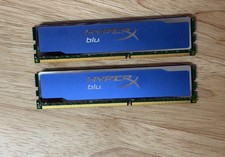
16GB (2x8GB) Kingston HyperX blu KHX1600C10D3B1/8G PC3-12800U DDR3 1600
$27.99
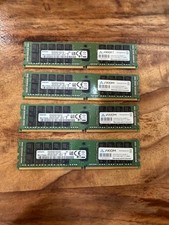
4 x Samsung DDR4 16GB 16GB 2Rx4 PC4-2400T-RA1-11-MC0 M393A2G40EB1-CRC 64G total
$300.00
DDR4 Laptop RAM 4GB 8GB 16GB 32GB 2400 2666 3200 Samsung Hynix
$66.00
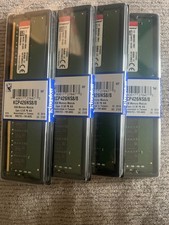
NEW Kingston 8GB DDR4 2666MHz Desktop RAM KCP426NS8/8 PC4-21300
$30.00
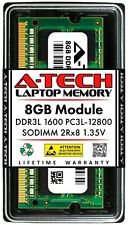
A-Tech 8GB DDR3 1600 PC3-12800 Laptop SODIMM 204-Pin Memory RAM PC3L DDR3L 1x 8G
$21.68
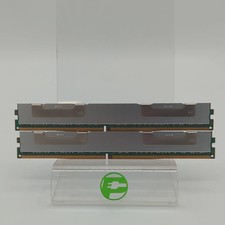
Samsung W03J0009150379F87A 64GB (2x32GB) RAM DDR4 2400MHz CRC0Y
$179.99
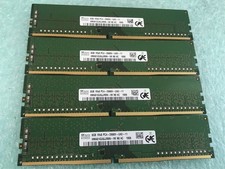
SK hynix 32GB(4 x 8GB) HMA81GU6JJR8N-VK PC4-2666V DDR4 Desktop RAM - CR337A
$89.95
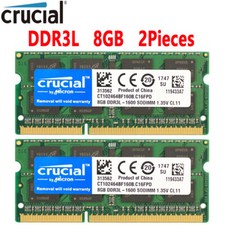
Crucial DDR3L 16GB 2 x 8GB 1600 MHz PC3L-12800 Laptop RAM Sodimm Memory 1.35V
$41.00
G.SKILL Trident Z RGB 16GB (2x8GB) DDR4-3000 DDR4 DIMM RAM F4-3000C16S
$70.00
Lot of 2 Kingston Fury 8GB (4x4GB) HX316C10FK2/8 DDR3-1600MHz Ram
$50.35



 Reply With Quote