-
Persistent Changes V6.2.1
Hi, Have just started using the above live CD. Successfully loaded the OS into RAM and wondered if it is possible to save system changes to USB and then continue from that point at the next live CD reboot. Thanks in advance. Dyfi.
-

Originally Posted by
dyfi

Hi, Have just started using the above live CD. Successfully loaded the OS into RAM and wondered if it is possible to save system changes to USB and then continue from that point at the next live CD reboot. Thanks in advance. Dyfi.
Is the flash drive big enough to do an install on? I used an 8GB flash with a DVD-image, and made a 4GB persistent file store. If it's not big enough, then look in the cheatcodes file on the disk to see what looks promising.
Cheers!
Krishna 
-
Hi, Thank you for answering my query. I will purchase a new USB flash drive with sufficient space. What I need to clarify is :- Can I command to boot from that USB during the next live CD startup? Regards, Dyfi
-
Here is a link to pricing (~$23 with shipping) on the 8GB one I used. It's very fast, highly reliable, etc. If your BIOS will not boot to USB, you can use a CD and the command
Code:
knoppix fromhd=/dev/sdb1
or some such.
Cheers!
Krishna
-
Administrator
Site Admin-
Originally Posted by
krishna.murphy
Here is a link to pricing (~$23 with shipping) on the 8GB one...
Or get the 8 gig one I have for 13.95 shipped or even $11.95 with the coupon code MLC114196101816NL1:
http://www.meritline.com/a-data-c008...--p-55267.aspx
I'm quite happy with it.
---
Verifying of md5 checksum and burning a CD at slow speed are important.
-
Originally Posted by
Harry Kuhman
Different strokes for different folks. I don't have one, but these reviews suggest that it's not ideal for storing your OS. I'd happily use one for (say) documents, but not for movies or Knoppix.
Cheers!
Krishna
-
Senior Member
registered user
Originally Posted by
dyfi
Hi, Thank you for answering my query. I will purchase a new USB flash drive with sufficient space. What I need to clarify is :- Can I command to boot from that USB during the next live CD startup? Regards, Dyfi
Your question, if I understand correctly is how to install KNOPPIX on the USB flash.
The answer to the question is there is a script called flash-knoppix which you can
run it from the commandline or you invoked it from the GUI :-
Code:
       $ su
       # flash-knoppix
Assuming that you are using LXDE, you can invoked it from the GUI :-
( LXDE menu ) --> Preferences --> "Install KNOPPIX to flash disk"
( bottom left icon )
You will typical only need 1 G flash for that purpose. But the resulting installation is again, like the live CD, whatever things you saved, are saved into the memory and are not persistent across reboot. To have persistency, this is when you will need about 4G or more space. The system will prompt you for creation of persistent store when you boot up from the USB flash.
-
Originally Posted by
kl522
Your question, if I understand correctly is how to install KNOPPIX on the USB flash.
The answer to the question is there is a script called flash-knoppix which you can
run it from the commandline or you invoked it from the GUI :-
Code:
       $ su
       # flash-knoppix
Assuming that you are using LXDE, you can invoked it from the GUI :-
( LXDE menu ) --> Preferences --> "Install KNOPPIX to flash disk"
( bottom left icon )
You will typical only need 1 G flash for that purpose.
It depends - I used a DVD image which required about 4 GB.
But the resulting installation is again, like the live CD, whatever things you saved, are saved into the memory and are not persistent across reboot. To have persistency, this is when you will need about 4G or more space.
When choosing a size, one may freely pick a value that they find suitable. If only 500K was chosen, (for example) then that amount of space could be used for adding software, saving settings, downloading files etc. If more space is made available, then that means there'll be more room for such things in the extfs persistent store.
The system will prompt you for creation of persistent store when you boot up from the USB flash.
Knoppix (likewise, Linux generally) is VERY flexible, and it's difficult to pose such limits and have them apply "across the board" - there are lots of exceptions.
Cheers!
Krishna
-
Administrator
Site Admin-
Originally Posted by
krishna.murphy
Different strokes for different folks. I don't have one, but
these reviews suggest that it's not ideal for storing your OS. I'd happily use one for (say) documents, but not for movies or Knoppix.
Cheers!
Krishna
I'm not very impressed by the reviews. The reviewers don't strike me as very scientific or precise, and that's not the same drive anyway. I can tell you that my drive has a read speed of 13.01 MB/sec as reported by USBDeview, which is better than a class 6 SDHC flash card that I've tested and almost as good as some SanDisk Extremme III SDHC cards that I own (they read at 15.65 MB/S). The Write speed is a bit lower (5.84 MB/S vs 9.80 MB/S) but read speed is more the determining factor for booting an OS or playing video (while Write speed is more of an issue for camera SDHC cards). I'm not saying this device's spec will be up to the Verbaitum device you referenced, but for less than half the cost I think it is a reasonable option. It by far outperforms other (smaller) flash drives that I own. I would be interested if you could post what you actually measure the Verbatim speed to be.
---
Verifying of md5 checksum and burning a CD at slow speed are important.
-
Greetings, I am a newbie as well, however - i have several reinstalls and reconfigs under my belt. I have done and HD Gui Install. Then - tohd, fromhd to create a persistent image - that now accepts my password, and has the correct system time, and of course Knoppix folder displayed on the desktop (which is how you know when everything is fine). Of course, I have one remaining challenge. (I also broke grub, lost Windows - had to do a "fixmbr" from recovery console - and now have Windows, Knoppix, and Grub all restored..... My remaining problem is getting to my persistent home without booting from the CD and using the fromhd command. I have tried the simple "e" edit at the Grub boot screen - inputting "fromhd=/dev/sda3", and "home=scan" to no avail. After about 20 hours, and finally resting I am in a good place now. Any advise on how to proceed with getting Grub to acknowledge the "poor-mans" install?
 Posting Permissions
- You may not post new threads
- You may not post replies
- You may not post attachments
- You may not edit your posts
-
Forum Rules

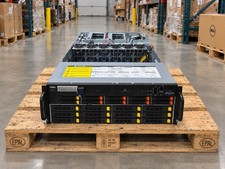
Gigabyte 4U AI Server 10x Nvidia GPU 2x Xeon Gold 6150 36 Core 2.7GHz DDR4 RAM
$1499.00
Dell EMC PowerEdge R440 Xeon silver 4215 2.5GHz 16 GB ram 2x 550W PSU No HDD
$275.00
Dell Poweredge R630 2x Xeon E5-2680 v3 2.5ghz 24-Cores / 64gb / Raid / 2x 1Tb
$374.99
867959-B21 HPE ProLiant DL360 G10 CTO Server W/ 2x 865414-B21 1x 840140-001
$245.00
Dell PowerEdge C4130 1U AI GPU Server | 2x E5-2690 v3 | 64gb Ram | 2x 1600W
$524.99
Dell PowerEdge C4130 1U AI GPU Server | 2x E6-2699 v3 | 128gb RAM | 2x 1600W
$899.99

Dell PowerEdge C4130 1U AI GPU Server | 2x E5-2680 v3 | 32gb Ram | 2x 1600W
$409.99
Dell Poweredge R730xd 12LFF 2*2660v4 4*1Gbe h730 2x 750W Server CTO
$308.00
Dell PowerEdge R530 2x E5-2630v4 H330 iDRAC8 Port Card Riser No PSU/RAM/HDD
$99.99
RDS CAL - Remote Desktop Services Windows Server 2019 50 User/Device Connections
$63.00



 Reply With Quote